Blown way by the success oh 100% Renewable Energy in El Hierro, Canary Islands, Spain
The World Future Council in cooperation with the Instituto Tecnológico de Canarias (ITC) hosted a study tour to El Hierro, Canary Islands, Spain for European Parliamentarians in order to provide hands-on capacity building on 100% Renewable Energy (RE). It provided an opportunity for Parliamentarians to meet practitioners and experts from the field to learn about potential policy outcomes and effects. The study tour did not only provide education and practical experiences but also an interactive and informal platform for knowledge exchange and discussions among policy makers.
Facts about El Hierro’s 100% RE strategy
How is the island supplied by 100% RE?
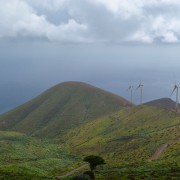
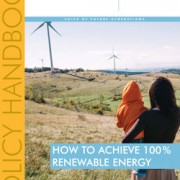
El Hierro’s 100% renewable energy strategy is anchored to its climate and geology. It benefits from stable and relatively strong winds throughout the year, and has appropriate island topography for the development of a pumped hydro storage system. As such, the majority of its 100% target is now being met by an 11.5MW wind farm, whose output is coupled with the functioning of a pumped hydro facility situated in a volcanic crater. When the winds are strong and the output from the farm exceeds the island’s demand (whose peak is approximately 7.5MW), the excess electricity is used to pump water into the upper reservoir constructed in empty crater for storage. When the winds are weak, or absent, the water stored in the upper reservoir is released and runs through hydro turbines (four units with a combined capacity of 11.3 MW) to produce electricity and storage in the lower reservoir. In this way, the pumped hydro system acts as a battery bank for the whole island. Another component of the system are the desalination plants that produce water for the islands’ residents – the plants are operated in an integrated manner with the wind farm, ensuring that the water supply for the island is also generated in a clean and sustainable way. Another component of the long term strategy is to replace the island’s 4,500 cars with electric vehicles, in order to further reduce reliance on imported fuels and promote sustainable development on the island. Finally, a focus has also emerged on encouraging the island’s agricultural industry to make greater use of bio-digesters in order to make use of local resources more efficiently.
What policy and governance framework enabled the success?
The Canary Islands’ policy framework integrated four political goals in a coherent and integrated vision, including 1) strengthening and diversifying the local economy, 2) energy security, 3) water security and finally 4) climate and environmental protection. El Hierro`s 100% RE strategy was enabled by the strong political will and commitment by the island`s government. Whereas the Regional Energy Plan for the Canary Islands foresaw a RE target of 36 % by 2020 for the region, El Hierro`s government officials achieved the implementation of 100% RE for their island. On the
regulatory side, Orden IET 1711, which sets the specific regulatory regime for the Wind-Pumped Hydro Power System of El Hierro, was key to realize the vision.
By proving its success, El Hierro inspired policy change for the Canary Islands as well. The regional parliament strongly supports the 100% RE target and has started to develop a robust policy framework to replicate the success on other islands. For example it just recently adopted the “decreto eólico 6” that simplifies the procedure for the authorisation of wind farms in the Canary Islands. Until now, wind farms were authorised through a tender process, which has delayed the installation of many of them. Now, the projects are authorised by the Regional Government, if all permissions are provided by the promoter (i.e. the promoter is not obliged to “wait” for the resolution of a tender process).
The initiative on El Hierro is a product of the close cooperation between the island government of the Canaries (which owns a 60% stake in the project), the Instituto Tecnológico de Canarias (which owns 10%), and a private Spanish energy and utility group (which owns the remaining 30%). Finally, there are several interconnected factors that have helped turn El Hierro into a leading example of a 100% renewable energy island. These include:
- a long tradition of environmental leadership,
- a sustained political vision among the local and regional governmental leaders
- a high level of environmental awareness among the population, including the potential
consequences of climate change
- a desire for greater self-sufficiency
What does 100% RE in El Hierro cost and how does it impact the economy?
The current electricity generation cost on El Hierro provides significant opportunity for lower cost alternatives and to displace the diesel generation on the island. The island’s oil use is currently approximately 40,000 barrels per year totalling approximately USD $4 Million in annual fuel import costs. Estimates suggest that the project will save the island approximately $2.5 Million in diesel costs every year. The remainder is currently used in the island’s transportation system. However, once the vehicle fleet is transitioned to rely on domestically produced electricity, this will effectively eliminate the island’s reliance on diesel power. This will not only save the island millions of dollars per year in imported fuels: it will also reduce its exposure to fossil fuel price volatility, making it more resilient to external shocks and strengthening the local economy by keeping more of its income in the region.
The Canary Islands are relatively isolated, approximately 300 kilometers from the coast of West Africa. This remoteness makes it more costly to import power system components such as generators, turbine towers, and distribution system infrastructure; it also makes it more expensive to fly in technical experts, such as engineers and project developers. This was partly overcome by partnering with, and building on the existing capacities of a local institute based in the main island Gran Canaría (ITC) that provided significant technical and strategic support over the course of the project. Drawing on the capacity of the ITC made it possible to develop a cluster of expertise in the Canary Islands. Hereby, the island has become a hub for knowledge sharing and for providing advisory services to other island governments as well as to stakeholders in countries with off-grid regions. This has had direct positive impact on the local economy and created jobs as well as new business models. Finally, the support of both local, national and international institutes, of business partners, as well as funding bodies such as the European Union played an important, if not invaluable role.
Lessons learnt from El Hierro’s 100% RE approach
As an island, El Hierro provides valuable lessons for other constituencies implementing 100% RE. This is particularly true for other islands as well as for countries with off-grid regions. Here, technology transfer and advice can facilitate the replication of El Hierro`s success model – particularly the provision of clean water through renewable energy powered desalination plants – which can stimulate rural development and improve the quality of life of the poor. Similarly, jurisdictions with an interconnected system and national grids can draw on the experiences of the island with a small population of about 10.000 inhabitants. Whereas the technological approach is probably not directly transferable to industrialized, grid-connected countries, the policy framework provides valuable lessons and experiences. 10 elements of a 100% RE policy framework, which the EL Hierro example proofs right:
- 100% RE is technically and economically feasible and is a matter of political will to achieve it.
- A stable, reliable and robust regulatory framework is the determining factor for the long-term success. The perceived risk of RE resulting from political uncertainty is hence the biggest barrier.
- Energy in many parts of the world is closely related to freshwater: 100% RE can be achieved by adopting an integrated policy approach for the energy and water sector (incl. desalination and wastewater treatment).
- 100% RE is a tool for energy and water security: It reduces the jurisdiction`s exposure to fossil fuel price volatility and energy imports, making it more resilient to external shocks and strengthening the local economy by keeping more of its income in the region.
- 100% Renewable Energy can generate new economic activity, create jobs and is a tool to create socio-economic value in a society as well as diversify the local economy.
- A 100% renewable energy strategy must be anchored in the existing climate, socio-economic context and geology. There is no one-size-fits-all strategy and local feasibility studies should inform the implementation plan.
- 100% RE can generate significant cost savings.
- El Hierro suggests that a significant expansion of RE in the transport as well as in other sectors (water, heating/ cooling etc.) will need to become a strategic priority for governments to achieve 100% RE.
- By developing more efficient energy infrastructure, it becomes easier to develop, finance, and integrate the remaining infrastructure required to meet a jurisdiction’s energy needs with locally
available renewable resources.
- By providing market access to a wide range of stakeholders (incl. public and private ones), policy makers can help build positive synergies across the region and leverage investments.
Policy recommendations deriving from El Hierro’s 100% RE approach
For National Legislators
- Set a political 100% RE target to provide leadership and streamline actions and hence resources.
- Provide a robust, reliable and coherent policy framework that reflects long-term investment security.
- Develop an evidence-based and comprehensive narrative to communicate benefits and opportunities of RE to the public.
- Simplify administrative procedures to reduce costs and enable investments.
- Electrify the heating/cooling and transport sector
- Adopt an integrated approach to fiscal, education, infrastructure, economic and energy policy.
- Develop efficient energy infrastructure which include the reduction of energy demand as well as the establishment of integrated systems to enhance energy efficiency.
- Implement inclusive policy frameworks that allow a broad range of public and private stakeholders to participate and new business models to emerge.
- Foster sustained citizen engagement to ensure acceptance and maximize the benefits for the people.
- Strengthen and empower regional governments to develop regulatory frameworks based on local and regional conditions (e.g. distinguish between islands and main land)
For European Legislators
- Phase-out all direct and indirect subsidies for a fossil fuel-based energy system.
- Develop a fiscal policy framework for RE.
- Develop binding RE targets and a robust frameworks beyond 2020 for RE with ambition and leadership.
- Provide funding for RE related infrastructure development as RE leads to profound changes in the way energy system.
- Establish an Energy Union that builds on 100% RE to achieve energy security, sustainability and economic competitiveness.
- Strengthen local and regional governments to adopt and develop adequate energy solutions for the respected area.
- Ensure full and active participation of regions, communities/cities, and local authorities in the Energy Union.
- Include the narrative of a feasible and viable 100% RE target in the Paris process by referring to examples.
Next steps
- MEPs host a Lunch Debate in the European Parliament to enhance the debate on 100% RE with other MEPs and members of the commission.
- MEPs explore opportunities to highlight the need for a national binding RE targets in the EU and putting RE at the heart of the Energy Union.
- The group contributes to fostering the positive communication around RE as a solution to Climate Change and a tool to spur economic and social development.
- Peter Liese reaches out to EU Commissioner Arias Cañete.
- Eva Kaili and Marijana Petir present the El Hierro as a case study for the feasibility of 100% RE in the STOA Panel.
- Boleslaw Piecha explores opportunities to engage Polish communities and policy makers in the debate on 100% RE.
- Marijana Petir explores opportunities to present El Hierro as a case study for the feasibility of 100% RE in Croatia.
- Eva Kaili and Marijana Petir explore opportunities for follow-up study tours to Croatia and Greece.