FPA 2012 goes to Palau
Press release – for immediate release

Press release – for immediate release

Work is essential for realizing other human rights and it forms an inseparable and inherent part of human dignity. Employment of persons with disabilities is about the opportunity to gain a living by work freely chosen or accepted in a labour market and work environment that is open, inclusive and accessible.
Hence, the Zero Project 2017 is focusing on Work, Employment, and Vocational Education and Training, and our call for nominating innovative policies has just been launched!
Any type of policy can be nominated, concerning:
Read the instructions first, complete the nomination form (available in several languages) and then send the nomination form to: i.heindorf@zeroproject.org by May 15, 2016 (23:59 CET).
If selected, the nomination will be included as an “Innovative Policy 2017” in the Zero Project Report and on our Website. Nominated organizations as well as their nominators will be invited to become part of the Zero Project expert network. Moreover, representatives of the most outstanding Innovative Policies will be invited to present at the Zero Project Conference in February 2017 in Vienna (Austria).
We are looking forward to receiving your nomination!
The Zero Project Team & Zero Project Partners
This article was originally published on zeroproject.org

Oral hearings on the preliminary phase of the nuclear disarmament cases brought by the Marshall Islands against India, Pakistan and the United Kingdom took place at the International Court of Justice in The Hague from 7-16 March. Members of the World Future Council have been involved in this unprecedented legal action since its launch in 2014 and some were present during the oral arguments at the Court. This Q&A, created by the Nuclear Peace Foundation, explains the cases.
The International Court of Justice (ICJ) is the principal judicial organ of the United Nations (UN). It was established in 1945 by the UN Charter. The seat of the Court is at the Peace Palace in The Hague, Netherlands. The Court’s role is to settle, in accordance with international law, legal disputes submitted to it by States and to give advisory opinions on legal questions referred to it by authorized UN bodies and agencies. The Court’s 15 judges are elected by the UN General Assembly and the Security Council.
The Republic of the Marshall Islands (RMI) has a unique and devastating history with nuclear weapons. From 1946 – 1958 the United States conducted 67 nuclear weapons test explosions over the Marshall Islands, the equivalent of 1.7 Hiroshima-sized bombs daily for 12 years. Castle Bravo, the largest bomb ever tested, was 1000 times more powerful than the Hiroshima bomb. Birth defects never seen before and other radiation-related health effects continue to plague the Marshallese people.
On April 24, 2014 the RMI filed individual Applications in the ICJ instituting proceedings against the nine nuclear-armed States: the U.S., Russia, the UK, France, China, India, Israel, Pakistan and North Korea. The RMI contends that each of these States is in breach of its obligations under the Nuclear Non-Proliferation Treaty (NPT) and/or customary international law to end the nuclear arms race and to engage in negotiations on nuclear disarmament.
Article VI of the NPT states: “Each of the Parties to the Treaty undertakes to pursue negotiations in good faith on effective measures relating to cessation of the nuclear arms race at an early date and to nuclear disarmament, and on a treaty on general and complete disarmament under strict and effective international control.” The UK is a founding member of the NPT, which entered into force in 1970. The U.S., Russia, France and China are also nuclear-armed members of the NPT; nuclear-armed India, Israel, Pakistan and North Korea are not. The RMI joined the Treaty in 1995 as a non-nuclear-weapon State and in turn received the binding legal promise of the States parties to the Treaty, including the nuclear-armed States.
In a 1996 Advisory Opinion, the ICJ issued an authoritative interpretation of Article VI and recognized a parallel customary international law obligation, concluding unanimously: “There exists an obligation to pursue in good faith and bring to a conclusion negotiations leading to nuclear disarmament in all its aspects under strict and effective international control.” This Opinion is not limited to NPT members; it applies to all States.
No negotiations on nuclear disarmament have ever been initiated and all of the nuclear-armed states are currently engaged in programs to modernize and qualitatively improve their nuclear arsenals, with an eye toward their indefinite retention. India and Pakistan are also engaged in quantitative arms racing.
At this time, only the UK, India and Pakistan – among the nuclear-armed states – accept the compulsory jurisdiction of the ICJ. The other nuclear-armed states were invited to respond to the Applications submitted by the RMI. China declined; the others did not respond.
This stage of the cases was limited to preliminary objections. The UK and India claimed that they have strong records of support for nuclear disarmament, arguing therefore that there is no dispute for the Court to adjudicate. The RMI countered that actions speak louder than words, citing the UK’s consistent record of voting against nuclear disarmament resolutions in the UN General Assembly and its plans to replace its Trident nuclear weapons system. With respect to India and Pakistan, the RMI cited programs underway for expansion, improvement and diversification of their nuclear arsenals. The UK and India also argued that the cases cannot proceed without other states possessing nuclear arms being before the Court; that the relief requested would be ineffective; and that various exceptions to their declarations accepting the jurisdiction of the Court apply, excluding jurisdiction.
Pakistan withdrew from participation in the oral pleadings at the last minute, declaring it had nothing to add to its written submission.
The ICJ will issue separate rulings in each case, probably within three to six months. If the Court rules in favor of the RMI, the cases will move to the merits phase and more written arguments and hearings will be scheduled. If the Court rules against the RMI in any case, that case will be over.
The RMI is asking the Court to declare that the UK is in violation of its obligations under Article VI of the NPT and customary international law by failing to pursue in good faith negotiations leading to nuclear disarmament, by taking action to qualitatively improve its nuclear weapons system and to maintain and modernize for the indefinite future, and by failing to pursue negotiations that would end nuclear arms racing. The RMI also requests the Court to order the UK to take all steps necessary to comply with its obligations under Article VI of the NPT and under customary international law within one year of the Judgement, including the pursuit of negotiations in good faith aimed at the conclusion of a convention on nuclear disarmament under strict and effective international control.
The RMI is asking the Court to declare that India and Pakistan are in violation of their obligations under customary international law, by failing to pursue in good faith and bring to a conclusion negotiations leading to nuclear disarmament, by failing to pursue negotiations on cessation of the nuclear arms race, and by engaging in the quantitative buildup and qualitative improvement of their nuclear forces to maintain them for the indefinite future, contrary to the objectives of nuclear disarmament and cessation of the nuclear arms race. The RMI also requests the Court to order India and Pakistan to take all steps necessary to comply with its obligations under customary international law with respect to cessation of the nuclear arms race at an early date and nuclear disarmament within one year of the Judgement, including the pursuit of negotiations in good faith aimed at the conclusion of a convention on nuclear disarmament strict and effective international control.
The RMI is not seeking monetary compensation in these cases.
A. General information about the cases is available at: nuclearzero.org. Written submissions by the RMI, UK, India and Pakistan, and verbatim records of the oral pleadings are posted at http://www.icj-cij.org/docket/index.php?p1=3&p2=3 Videos and photos from the oral pleadings are posted at www.icj-cij.org/multimedia.
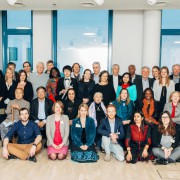
More than 50 Councillors, Ambassadors and members of the Supervisory Board convened for our Annual General Meeting “Identifying Policy Solutions for a World of Growing Disorder and Inter-linked Crises” in Hamburg, Germany from 5-7 March. Councillors and Youth Ambassador Kehkashan Basu will provide keynote speeches and Councillors from all continents provided their view of the future and ways to achieve a peaceful, sustainable and just future.
Every child has the same human rights as adults. These include the right to life, food, health, education, development, a clean environment and the right to be heard. However, despite recent advances, many children today still suffer from poverty, gender inequality, homelessness, abuse, preventable diseases, and unequal access to education. Their rights are forgotten or ignored. Approximately 300 million children go to bed hungry every night. Environmental degradation and conflicts are forcing children to flee their familiar surroundings and live as refugees. Others are forced into exploitative work and cannot exercise their right to education, robbing them of the chance to create a better future.
Good laws and policies – and their effective implementation – are the foundation for protecting the rights of girls and boys that were enshrined in the UN Convention on the Rights of Children in 1989. However, children’s rights are not brought to life through pronouncements; they require resolve from our leaders and most importantly practical implementation on the ground.
It is now up to national governments to show the political will to ramp up actions at home and lead the response against the violation of children’s rights by ensuring such international commitments are adhered to through laws. Civil society must also play its part to ensure that ignorance and inaction are no longer an option! Instead of asking why things need to change, we have to finally start focusing on the how and highlight solutions that work!
The good news is solutions exist
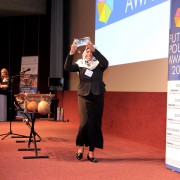
This year, the World Future Council is celebrating the best laws and policies to secure children’s rights, with its ‘Future Policy Award’, to raise global awareness of those solutions that successfully overcome the barriers preventing children from enjoying their rights to a clean and healthy environment, to education, to protection (from child labour, child trafficking, child marriage) and to participation. Only by highlighting these solutions can we speed up policy action towards just, sustainable and peaceful societies for future generations.
From America, to Europe, Africa, Asia and Oceania, we have already seen significant changes in policies and attitudes towards children and their rights that provide hope for the future. We are in a unique position to learn from pioneers who have shown us how it can be done. Now it is up to us to replicate and build on their success stories. Fortunately, we do not have to start from scratch.
In Zanzibar, the “Children’s Act” which won this year’s Future Policy ‘Gold Award’has proven to be an effective response to child abuse and violence, while promoting and protecting child rights at the same time. The law has led to a marked societal change in attitudes towards children in the country. Alongside a revamped child protection system, many schools are now piloting alternatives to the previously widespread use of corporal punishment and thousands of children have been assisted in returning to school from harmful work. A pioneering feature of the law was a village-level child consultation process which provided young people with an understanding of the law and their rights, giving them the opportunity to voice their priorities and feed into the law’s drafting process. Their views are now represented by over 200 active Children’s Councils.
[borlabs-cookie type=”content-blocker”]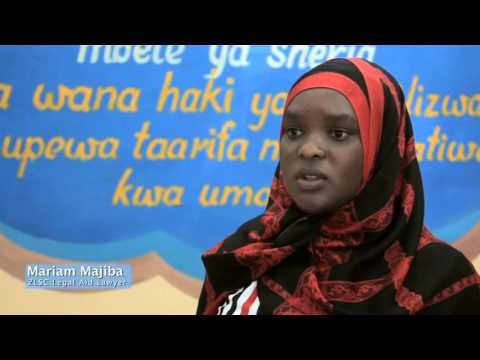
The state of Maryland in the US was the first to require students to be environmentally literate as a high school graduation requirement. The results point to positive school-wide impacts in knowledge, behaviour and local action projects as well as broad improvements in student’s learning outcomes across a range of subjects. Other states, such as Kentucky and Utah have since developed education plans based on Maryland’s “Environmental Literacy Standards”.
Finland’s ‘Basic Education Act’, adopted in 1998, guarantees children’s equal access to high-quality education and training, irrespective of ethnic origin, age, wealth, language or location. Finland’s holistic and trust based education system produces excellent results, both in terms of child well-being and international test scores.
[borlabs-cookie type=”content-blocker”]
In Sweden, the Children and Parent Code prohibits all corporal punishment and other humiliating treatment of children. It has fostered a profound change of attitude across Swedish society in relation to violence against children, gaining a very high level of awareness and support, including from children. Sweden is also working with other states to promote universal prohibition of all violent punishment of children.
Finally, Argentina’s Supreme Court’s Judgement which upheld the country’s constitutional right ‘to an environment which is healthy, balanced and suitable for human development’ led to a comprehensive inspection, restoration and clean-up plan for the heavily polluted Matanza-Riachuelo river basin in Buenos Aires. These efforts have provided clean drinking water and sanitation to over a million people and are directly benefitting local children through access to health care and relocated housing. It demonstrates what can be achieved when judges start recognizing and enforcing environmental rights which are included (but not enforced) in three quarters of the world’s national constitutions.
[borlabs-cookie type=”content-blocker”]
Inaction no longer an option
By looking at these examples, we can lay out the policy incentives required to build a world of growing solutions, rather than growing problems. It is essential that we highlight these best policies, engage our communities to spread the word about them and empower policy-makers to implement them. Action requires more than intent and good will: The time has come for world leaders to step up to the challenge and leverage their powers on behalf of the youngest members of our societies.
Giving these policies the recognition they deserve by awarding them with the Future Policy Award is only the beginning. We need to raise more global awareness of these pioneering examples and assist policy-makers to develop and implement similar initiatives. The time to act is now!
Originally published on


Maryland was honored Tuesday for its statewide environmental literacy standards with a silver 2015 Future Policy Award from the World Future Council, the Inter-Parliamentary Union and UNICEF.
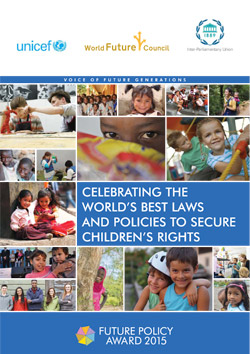
In 2015, the World Future Council’s Future Policy Award seeks to highlight innovative laws and policies that contribute to promoting, realising and securing children’s rights to provision, protection and participation as stated in the UN-CRC and its Optional Protocols. We encouraged the nomination of laws and policies that are successfully overcoming the barriers that prevent children from enjoying their rights to education, participation, and to protection – with a special focus on child labour, child trafficking and child marriage. We also looked into measures that acknowledge the interdependence of environmental rights and children’s rights, and the need to strengthen and spread legislative advances in environmental protection.