Making malnutrition a thing of the past
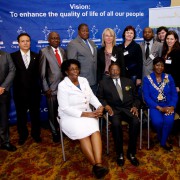
Three-day workshop on food and nutrition security in Windhoek kicks off with keynote by Namibian Deputy Prime Minister, the Honourable Marco Hausiku

Three-day workshop on food and nutrition security in Windhoek kicks off with keynote by Namibian Deputy Prime Minister, the Honourable Marco Hausiku
Bosnia and Herzegovina and Argentina are culturally, linguistically and geographically diverse nations. However, both are fighting to realise change and bring about a new direction in their country’s development.
Over 750,000 illicit weapons and 16,000 tonnes of ammunition currently circulate within the borders of Bosnia and Herzegovina. Easy access to weapons largely left over from the conflict in the 90’s has led to these circulating remnants of war being involved in more than 10 violent incidents each week.
Argentina too has also faced risks caused by the availability of guns and a lack of gun violence education. In 2004, a 15 year old boy killed three classmates in Southern Argentina, wounding five. It is clear that despite their many evident differences, firearm awareness actions needs to be taken to curb the blight of gun violence in both nations for future generations.
“Tragedies caused by guns and other small arms are nearly a daily occurrence. Without the widespread availability of these weapons such tragedies could not occur. Further, guns can play no positive role in resolving conflicts or achieving reconciliation between conflicting parties. Resolving conflicts requires peaceful processes, including negotiations and diplomacy. Peace cannot be attained by either random or targeted killings – thus, the importance of disarmament, gun control and a non-killing ethic.” – David Krieger WFC Councillor & President, Nuclear Age Peace Foundation.
As part of our follow-up activities to the 2013 Future Policy Award on Disarmament, on March 6-7, the World Future Council together with UNDP Bosnia and Herzegovinas ‘Choose Life Without Weapons‘ coalition provided an opportunity for governmental entities from Argentina and Bosnia and Herzegovina to come together to exchange their experiences in combating the blight of the small arms and light weapons within their unique national contexts.
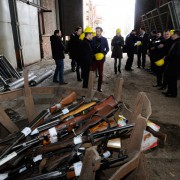
A conference at UN House in Sarajevo on 6 March allowed participants to share lessons learnt from their arms control programmes, while a visit to Banja Luka on 7 March gave participants the chance to witness and participate in the melting of collected weapons, which are then recycled to manufacture spare parts for windmills and other public infrastructure.
In 2013, Argentina’s ‘National Programme for the Voluntary Surrender of Firearms’ was recognised with a Silver Future Policy Award by the World Future Council, in collaboration with the UN Office for Disarmament Affairs and the Inter-Parliamentary Union. Under the programme, the governmental agency RENAR has successfully collaborated with civil society in reducing the number of illicit firearms while promoting a culture more focused on non-violence and peaceful conflict resolution.
The kick-off event in Sarajevo included the screening of the documentary Football Rebels and the football match between Bosnia and Herzegovina and Argentina later that evening.
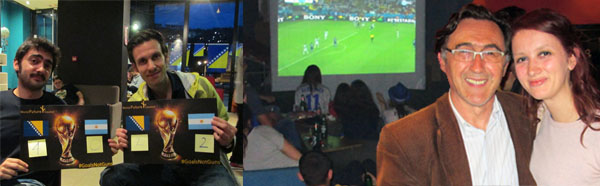
 Choose life without weapons was launched in 2013 by UNDP, and their partners, to prompt action and open discourse over the issue of gun violence in Bosnia and Herzegovina.
The campaign encourages citizens to take advantage of an amnesty law allowing weapons and explosive devices to be handed over to the police without legal repercussions. Collected weapons are then melted and recycled into components for infrastructural development across the country.
Argentina similarly encouraged sustainable action against armed violence through the formation of The Argentine Disarmament Network, a coalition of civil society organisations attempting to tackle armed violence.
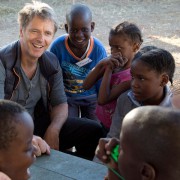
Ensuring enough healthy food for every child is one of the aims of our work. Our ambassador, German TV presenter Jörg Pilawa, visited various aid projects in Namibia, to understand the food security situation there.
Press release – for immediate release

Carbon Labelling is supported in the framework of the Intelligent Energy Europe programme
It has been shown that the carbon footprint of food products (‘foodprint’) can vary substantially. Depending on its production method (organic versus chemical), its content (meat versus vegetarian or vegan), transport routes (air freight, sea freight or local), processing method (fresh versus deep-frozen) and disposal of residues (use as organic fertilizer versus waste), each food item is responsible for a certain amount of GHG emissions during its life-cycle.
Making this information available to the consumer increases transparency in the food market, raises awareness of the consumer, creates incentives for the industry to lower its carbon footprint, and rewards climate friendly products. Consumers should know whether the organic kiwi from New Zealand or the home grown chemically fertilized apple does more harm to the climate. In general, environmental labelling has been a success story since the 1980s. Labels, such as the Energy Star, energy efficiency ratings or the Nordic Swan label have changed the behaviour of consumers and manufacturers. An Eurobarometer survey showed that for an overwhelming majority of Europeans (83 percent) the impact of a product on the environment plays an important aspect in their purchasing decisions.
An evaluation of the specific circumstances of the political and regulatory environment will determine the best choice in each case. Whereas a mandatory label ensures a broad participation, voluntary schemes might have a better acceptance in the industry. A food label should be based on total lifecycle emissions, as opposed to considering only the use-phase. Possible are both, comparative labels which provide consumers with product information through use of a specific number (e. g. ‘1 kg CO2’) or rating (e. g. A–F or 1–5 stars), or endorsement labels which prove that the product meets certain criteria (e. g. below average carbon footprint).
Implementing new labelling schemes necessitates conformity assessment procedures involving testing, inspection, certification, accreditation and metrology. These processes are essential for the effective implementation and acceptance of the scheme.
The EU Commission has taken a first look at this issue but, not surprisingly, has received opposition from the food industry. However, the example of the UK Carbon Label and the Swedish climate labelling initiative show that the concept can be implemented and, with the assistance of governments and industry, can be established on a larger scale.
In Sweden, the two major certification bodies, KRAV and Swedish Seal, have developed a climate label for food. As the project has been joined by several major food and agriculture companies, the Swedish climate labelling initiative has become the first comprehensive and country wide policy of its kind in Europe.
The climate label covers the food chain from farming to the sale of the produce. So far, criteria for meat, fish, milk, greenhouse vegetables and agricultural crops have been set. Food produced and distributed with at least 25 percent less GHG than comparable products can be labelled with a respective note. In this way the label focuses on the climate friendliest products within a group, but does not help the consumer to choose between meat and beans.
The climate label is accompanied by an information and education campaign, which resulted in recommendations for climate compatible nourishment. In addition, the initiative works with the industry to implement measures to reduce the GHG emissions of food production.
According to press reports (Spiegel-online of 7th Nov. 2009) the climate label increased the sale of Max burgers by 20 percent. Experts are cited to expect a 50 percent reduction of GHG emissions in the Swedish food industry, if the population would switch to climate friendly alimentation. The labelling initiative maintains that 60 percent of consumers would like to see a climate label on products.
Anna Richert, climate expert of the label initiative, says: “The strength of the label is that reductions in climate impact have been made wherever possible. The producer participates in making the food chain more sustainable.”
Click here to access Klimatmärkning homepage.