Every year India struggles with natural conditions of drifting dust from the desert Thar[1] which are aggravated by human impact[2] and lead to environmentally, socially and economically costly air pollution. With the enabling policy framework, a proven technology could be part of a feasible scheme tackling all anthropogenic drivers at once – and ideally lead to a reduction of air pollution by up to 90%.
Starting a few months ago, India’s North has made headlines when air pollution reached an air quality index (AQI) of 1,001[3] – exceeding safe levels by a multitude of ten. In the national Capital Region of Delhi alone 45 million people[4] have been affected, causing a spike in complaints of respiratory problems and an emergency state, declared by the Indian Medical Association.[5]
Even though the news around the topic subsided, the officially monitored AQI which are even higher in the proximity of roads[6] within major cities like Delhi, Mumbai, Chennai, Hyderabad and Kolkata, continue to range around hazardous levels[7]. Inhalation of this air is comparable to smoking several packs of cigarettes a day[8] [9] and serious respiratory effects in the general population can be expected while even putting susceptible groups at risk of premature death[10].

Figure 1: Haze over North India in late 2017. (Source: NASA, 2017)
The death toll of air pollution in India was the highest of all countries around the world with 2,5 million in 2015.[11] A global UNICEF study found recently, that over 90% of children are breathing polluted air not matching WHO guidelines and 17 million infants are exposed to levels six times the approved norms.[12] Furthermore, household air pollution was recently discovered to be insalubrious even before birth, reducing birth weight, pregnancy duration and doubling perinatal mortality[13]. This effect is owed to the burning of traditional fuels which exposes mostly women to pulmonary and vision hazards of indoor air pollution.[14]
A study conducted by the World Bank concluded: The negative health impact of outdoor air pollution alone costs India 3% of its GDP[15] which translates to an equivalent loss of roughly 35 billion Euros every year. Research found a direct impact of the atmospheric pollution on agriculture with wheat yields of 2010 being on average up to 36% lower than usual all over India due to reduced intensity of sunlight and toxic ozone reaching the plants.[16] Additionally, increased amounts of carbon dioxide in the atmosphere[17] contribute to the greenhouse effect leading to more extreme and destructive weather events.
Two main causes for a myriad of manmade emission sources
In agricultural areas such as Punjab, the breadbasket of India, which singlehandedly produces 20% of India’s wheat and 10% of its rice[18], smoke blankets rise seasonally for several weeks despite a governmental ban when leftover straw stubble from mechanical harvesting is burned openly in the fields to clean the soil for new seeding [19] (see fig. 2).

Large-scale crop burning in India in 2017. (Source: Propakistani, 2016)
Then, metropolitan areas are covered by the drifting haze of crop burning in addition to the smoke of millions of wood cook stoves in and outside of the urban areas as well as countless emitters of sulfates, nitrates and black carbon such as automobiles, coal-fired power plants, incinerators, smelters or brick kilns.[20]
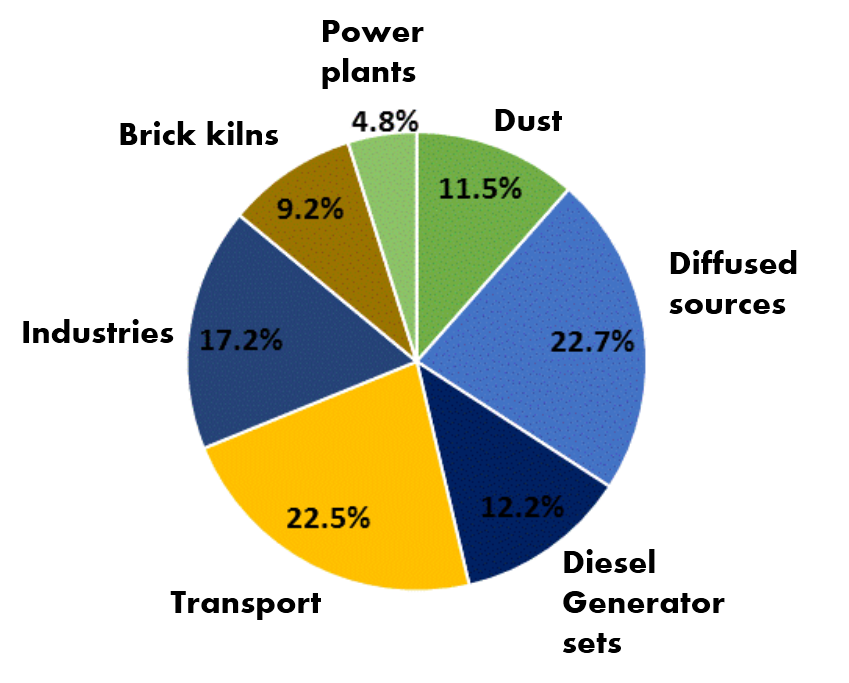
A comparison of several studies of Delhi shows the difficulty of solving the problem due to the relatively equal share of the main human-made sources of urban air pollution: Open burning of garbage and other diffused emitters contribute on average about a quarter, domestic or biomass burning as well as dust ranges around 15% while both traffic and industry (including coal power plants) are responsible for approximately one third.[21] [22]
However, understanding the reasons of air pollution, the interconnectedness of land and city and the amplification of fog and aerosol hazes[23] permits a vision for a future of clear skies and fresh breath. The main detrimental causes showed to be unsolvable if tackled one by one which is demonstrated by governmental emergency measures falling short every year.
Multiplying the negative causes turns into a feasible opportunity
The usually unused agricultural leftover biomass like paddy straw suddenly becomes an additional source of income for farmers as it already begins to prove itself as a viable source for power generation in rural India, offering employment for thousands of people. The calorific value per kilogram of coal and paddy straw are comparable while it burns cleanly in boilers with an efficiency as high as 99%. Combustion technology is commercialized and alone in the state of Punjab 332.5 MW of agro-waste based power projects are planned.[24]
These power plants can sell their power due to the “New & Renewable Sources of Energy Policy” and generate income under a Clean Development Mechanism while suppling millions of kWh to the grid for years. [25] Even individual households value the significant financial benefit of a carbon credit scheme which earns them up to 500 Rupees per month in a pilot project and convinces them to maintain the use of improved cook stoves.[26]
There are numerous reasons aside from health benefits for extending the understanding of sustainable cooking beyond improved cook stoves[27]. A new one is provided by a recent study, that noted villagers truly wish for cooking like in the cities – preferably with LPG which is out of reach for many due to its higher costs compared to wood.[28] The so-called producer gas of low-cost straw-based power plants is an ideal replacement of a cleanly burning fuel, reducing indoor air pollution significantly in poor or disconnected rural and urban households alike.
Moreover, the processing of biomass and organic waste opens the opportunity of bio-oil production which can be handled exactly like a petroleum-based product to power suited diesel generators and fuel traffic in the cities.[29] This not only reduces transport emissions greatly but adds value to the commonly high share of organic waste (~30%) in Indian cities[30], attracting the informal sector in waste collection and reducing open garbage burning.
If now the government would take a leap forward by providing legislative support for this scheme in a holistic framework and additionally phase out coal power plants, manmade air pollution could ideally be reduced by roughly up to 90% through counteracting the aforementioned emission sources. In addition to environmental and social health improvements, the positive economic impact would be substantial: An IRENA study estimated a total benefit of 59 to 224 billion USD in savings following a restructuring of the power sector.[31] India’s INDC target of 40% renewable energy in 2030 is a promising step into the right direction.[32]
– written by Lisa Harseim –
[1] https://earthobservatory.nasa.gov/IOTD/view.php?id=84731
[2] http://www.urbanemissions.info/wp-content/uploads/images/PMSA-Delhi-UEinfo-2013-Study.png
[3] https://visibleearth.nasa.gov/view.php?id=91240
[4] https://www.nytimes.com/2017/11/07/world/asia/delhi-pollution-gas-chamber.html?mc=adintl&mcid=facebook&mccr=edit&ad-keywords=GlobalTruth
[5] https://www.visibleearth.nasa.gov/view.php?id=86982
[6] http://www.dw.com/en/study-offers-new-insight-into-new-delhis-air-pollution-woes/a-18105674
[7] http://clonewdelhi.com/custom/AQI/missionindiaaqi.php#
[8] https://www.nytimes.com/2017/11/07/world/asia/delhi-pollution-gas-chamber.html?mc=adintl&mcid=facebook&mccr=edit&ad-keywords=GlobalTruth
[9] http://www.theweek.in/columns/shashi-tharoor/dont-hold-your-breath.html
[10] https://www.visibleearth.nasa.gov/view.php?id=86982
[11] https://www.nytimes.com/2017/11/07/world/asia/delhi-pollution-gas-chamber.html?mc=adintl&mcid=facebook&mccr=edit&ad-keywords=GlobalTruth
[12] http://cleancookstoves.org/about/news/01-04-2018-new-study-shows-clean-cooking-can-lead-to-increased-birth-weight-in-newborns.html
[13] https://www.sciencedirect.com/science/article/pii/S0160412017312448
[14] https://www.solarquarter.com/index.php/resources/83-industry-reports/6245-remap-renewable-energy-prospects-for-india
[15] http://www.worldbank.org/en/news/press-release/2013/07/17/india-green-growth-necessary-and-affordable-for-india-says-new-world-bank-report
[16] https://www.ncbi.nlm.nih.gov/pmc/articles/PMC4246269/
[17] https://link.springer.com/chapter/10.1007/978-81-322-2014-5_4#page-1
[18] https://www.visibleearth.nasa.gov/view.php?id=86982
[19] http://www.dailymail.co.uk/indiahome/indianews/article-5055737/Crop-burning-ban-goes-flames-Punjab-Haryana.html
[20] https://earthobservatory.nasa.gov/IOTD/view.php?id=84731
[21] http://www.dw.com/en/study-offers-new-insight-into-new-delhis-air-pollution-woes/a-18105674
[22] www.urbanemissions.info
[23] https://earthobservatory.nasa.gov/IOTD/view.php?id=84731
[24] https://link.springer.com/chapter/10.1007/978-81-322-2014-5_4#page-1
[25] https://link.springer.com/chapter/10.1007/978-81-322-2014-5_4#page-1
[26]https://www.povertyactionlab.org/sites/default/files/India_%20Cooking%20up%20a%20recipe%20for%20clean%20air%20%281%29.pdf
[27] https://www.worldfuturecouncil.org/file/2016/10/WFC_BeyondFire_web-version.pdf
[28] https://www.povertyactionlab.org/evaluation/cooking-stoves-indoor-air-pollution-and-respiratory-health-india
[29] https://link.springer.com/chapter/10.1007/978-81-322-2014-5_4#page-1
[30] http://www.academia.edu/6034600/State_of_municipal_solid_waste_management_in_Delhi_the_capital_of_India
[31] http://www.irena.org/publications/2017/May/Renewable-Energy-Prospects-for-India
[32] http://www.ren21.net/gsr-2017/pages/tables/tables/#table-R15