
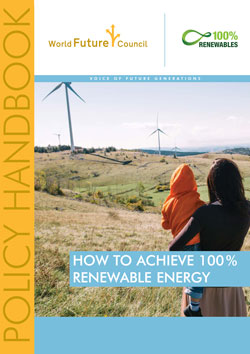
The goal of fully transitioning the world’s total energy mix toward renewable energy sources is no longer a utopian ideal: it is being achieved in a number of places around the world today. Hundreds of jurisdictions across the globe have set 100 % renewable energy (RE) targets and are beginning the journey toward a fully fossil- and nuclear-free society. In the process, these pioneers have been incubators of regionally appropriate best practices and policies.
This policy handbook takes a closer look at these early pioneers to provide inspiration and concrete examples to other jurisdictions that are aiming to embark on the same transformation. It analyzes case studies to identify drivers, barriers as well as facilitating factors and, from these, it derives policy recommendations to finally enable their transfer to other jurisdictions around the world.
Human impacts on the world’s landscapes are dominated by the ecological footprints of urban areas that now stretch across much of the globe. The World Future Council’s Regenerative Cities programme seeks to identify concepts and policies that help cities to harness their own regenerative capacity in order to reconcile the their ecological footprints with their geographical magnitude. The planning and management of new cities as well as the retrofitting of existing ones needs to undergo a profound paradigm shift. The urban metabolism must be transformed from its current operation as an inefficient and wasteful linear system into a resource-efficient and circular system.
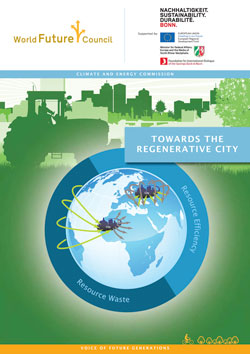
The planning of new cities as well as the retrofitting of existing ones needs to undergo a profound paradigm shift. The urban metabolism must be transformed from its current operation as an inefficient and wasteful linear input-output system into a resource-efficient and regenerative, circular system. This report is about operationalising and implementing the concept of regenerative cities.
Renewable Energy Feed-in Tariffs (REFiTs) have been successful at increasing the use of renewable technologies worldwide. REFiTs encourage investment in renewable energy generation – from individual home owners and communities to big companies – by guaranteeing to buy and pay for all the electricity produced.
While the majority of these installations have occurred in industrialised countries, particularly Europe, the African continent has significant untapped renewable energy potential. REFiTs have the potential to transform energy systems and societies in profound and tangible ways.
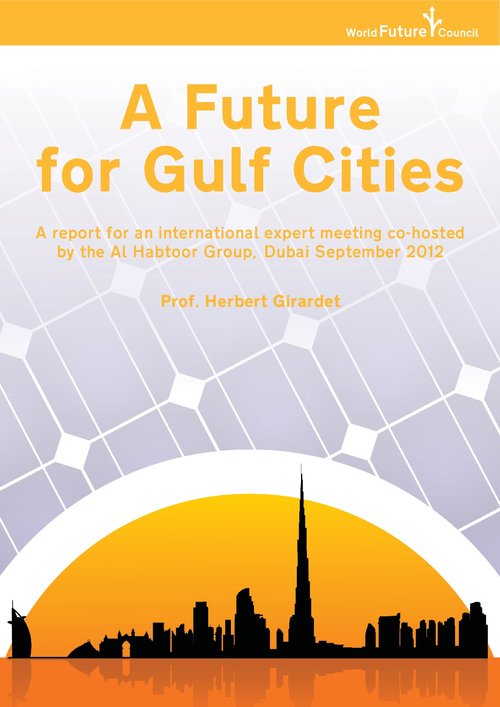
There is no better place to discuss the future for Gulf cities than in Dubai. This city shows us both what can be done and what must be done. Its growth from a small trading port on the edge of the desert to a global city in just a few decades shows the power of visionary leadership. This gives us hope that this city can, in the coming decades, mobilise the same vision and energy to regenerate itself into a pioneering post-modern city, using its resources and ingenuity to show how to win the coming battle for sustainability to which Maurice Strong refers.
This report is a documentation of the parliamentary hearing hosted by the World Future Council, the Nordic Folkecenter and the Climate Service Center (CSC) at the Helmholtz-Zentrum Geesthacht. The workshop took place on October 4th to 7th 2012 at the Nordic Folkecenter in Hurup Thy, Denmark. It provided a platform for policy makers and experts to share knowledge, exchange ideas, develop strategies and build up networks in order to implement the 100% Renewable Energies (RE) target across European regions. The overall goal was to enable decision makers from European regions to undertake the necessary political action to realize the 100% RE goal by presenting political instruments and strategies that showed success elsewhere in Europe. In this multi -stakeholder dialogue, 40 representatives from national, regional and local governments as well as academia and civil society from 15 European countries and Canada participated.
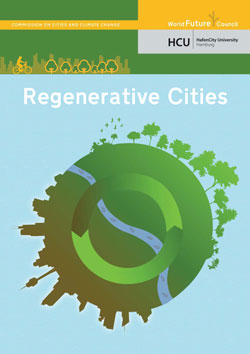
Creating regenerative cities primarily means one thing: initiating comprehensive political, financial and technological strategies for an environmentally restorative relationship between cities and the ecosystems from which they draw resources for their sustenance. Introducing “Agropolis”, “Petropolis” and “Ecopolis” this WFC brochure by WFC Honorary Councillor Herbert Girardet explains how such a healthy relationship can be built.
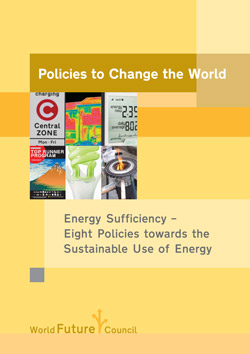
Policies to Change the World, Energy Sufficiency – Eight Policies towards the Sustainable Use of Energy, from the World Future Council, introduces the principle of energy sufficiency and explains why only efficiency and conservation can achieve the more ambitious energy reduction scenarios. It presents eight proven and effective policies to help reduce worldwide energy consumption: Energy audits for existing buildings, phasing out of incandescent light bulbs, energy performance contracting, incentivising combined heat/cooling energy and power, the ‘Top Runner’ programme, carbon-negative cooking, smart metering and area road pricing.