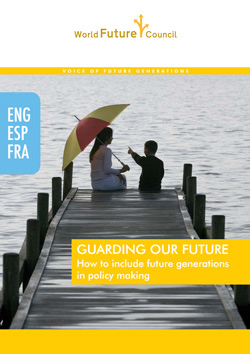
Guarding our Future
Abstract
Guarding our future: All over the world climate change, environmental destruction, financial crises, and the widening gap between rich and poor are spreading insecurity and fear. We know that big changes in running our societies are needed. Laudable declarations and inspiring ideas abound. Yet we seem to be experiencing deep inertia. How can we turn fine words into action?
Policy making seems to be stuck in a way of thinking that is inadequate in the face of severe global challenges. We have a collective responsibility to implement and deliver ambitious sustainable development strategies for an interconnected world of some 9.6 billion people by 2050. We believe there is enough wealth on the planet to provide peace and wellbeing for all.
If we update our policies to protect long-term interests. If the rules of engagement are fair and for the common good. If we protect diversity of life on this planet. The World Future Council is advocating a vision of Future Justice – common sense policy solutions that will benefit society as a whole and provide a high quality of life for generations to come.
Measuring the Long Term
Abstract
“The world’s continued fixation with economic growth ignores a rapid and largely irreversible depletion of natural resources that will seriously harm future generations. Coupled with the increasing short-termism of modern politics and a general inability to look beyond our own self-interests, the result is a crisis of opportunity for unborn generations. Long term perspectives are rarely factored into our decisions while future generations remain politically powerless; their interests limited to the whims of the present generations.”
How can we best assess how our current decisions and actions are impacting future generations? WFC Senior Policy Officer, Alistair Whitby, presents some of the most noticeable alternative indicators that can help governments and businesses with their long term planning and make some recommendations to ensure these efforts have real impact.
Help Ensure Every Child Born is Wanted
Abstract
The sustainable development goals (SDGs) set out by the UN in 2015 will drive the global development agenda on social, economic and environmental issues for the next 15 years. Out of the stated goals, none specifically refer to population policies. Yet coherent and sustainable population policies, including universal access to sexual and reproductive health rights, are necessary to achieve the majority of the development goals outlined. The Global Policy Action Plan (GPACT) recognises these links, and this paper elaborates on the necessity of coherent and future-proof population policies.

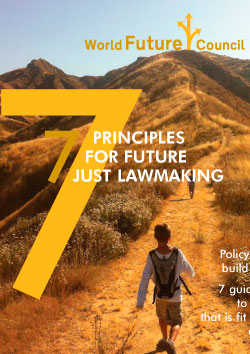
Seven Principles for Future Just Lawmaking
Abstract
Future Justice means putting the values that are essential to our survival at the heart of every law, and every policy. To help with this, we have developed seven policy principles for future just lawmaking.
Alternative Indicators for Wealth
Abstract
It is now widely recognised that the objectives that have dominated economic policy for the last 40 years and more – maximising Gross Domestic Product (GDP) and market efficiency – are no longer adequate goals for society. There is now a broad coalition that recognises that economic growth alone cannot deliver sustainability, social justice and improved well-being. Institutions such as Eurostat, the OECD, the World Bank, National Statistical Offices (NSOs) and others are responding to the desire from governments and civil society to consider a more nuanced set of economic policy objectives. At the same time non-governmental actors are using alternative ‘Beyond GDP’ indicators as an advocacy tool to promote more radical societal change including greater equality, higher levels of well-being for all and a vision of progress that is consistent with long-term environmental sustainability.
Crimes against Future Generations: A New Approach
Abstract
This legal working paper discusses the creation of a new international crime: crimes against future generations. The initiative of creating crimes against future generations grew from discussions held by the Commission on Future Justice set up by the World Future Council (WFC) to develop new laws and policies in order to guarantee human security, ecological integrity and social equity in the interest of future generations and was led by Hon. Christopher J. Weeramantry, Bianca Jagger, and Prof. Marie-Claire Cordonier Segger.
SUPPORTERS

NEWSLETTER